





1. Introduction to the Discovery
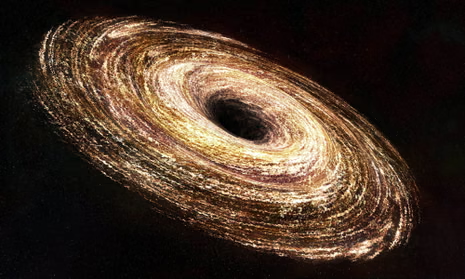
A gargantuan black hole has recently been discovered relatively close to Earth, capturing the attention of astronomers and space enthusiasts alike. This discovery is significant because it challenges previously held assumptions about the distribution and frequency of massive black holes in our cosmic neighborhood. Black holes are regions in space where gravity is so strong that not even light can escape, making them invisible to traditional telescopes. Detecting them typically involves observing their effects on nearby stars or gas clouds. The newly discovered black hole, due to its immense size and proximity, provides a unique opportunity for scientists to study its characteristics and influence on surrounding space in unprecedented detail. Its discovery could also shed light on the lifecycle of massive stars, the evolution of galaxies, and the mechanisms that lead to the formation of such colossal gravitational phenomena. Researchers are particularly excited because nearby black holes allow for more precise measurements, enabling insights into properties like mass, spin, and interaction with surrounding matter. The implications of this finding extend beyond astronomy, as studying black holes also tests the limits of physics, including Einstein’s theories of general relativity and the behavior of matter under extreme conditions. Understanding a black hole of this magnitude and relative closeness can help scientists refine models of galactic evolution, the role of black holes in shaping their environment, and potentially predict the behavior of similar objects elsewhere in the universe.
2. What Makes This Black Hole “Gargantuan”
The term “gargantuan” refers to the black hole’s extraordinary mass and size, which far surpasses typical stellar black holes. Most black holes are formed when massive stars collapse at the end of their life cycles, resulting in objects that are a few to tens of times the mass of our Sun. However, this newly discovered black hole is estimated to have a mass millions of times greater, placing it in the category of supermassive black holes, typically found at the centers of large galaxies. What makes this discovery particularly intriguing is that it exists in a region relatively close to Earth, outside the densely populated galactic centers where supermassive black holes are normally observed. Its sheer size generates gravitational effects that influence surrounding matter on a scale far larger than ordinary black holes, pulling in gas, dust, and even stars in its vicinity. The gravitational forces around such a black hole warp spacetime itself, creating extreme conditions that allow scientists to test theories about the behavior of matter and energy under intense gravitational pull. The discovery also raises questions about its formation, growth, and migration, challenging the conventional understanding that such massive black holes are confined to galactic nuclei. Studying a black hole of this magnitude so near Earth provides astronomers with a rare laboratory to explore these extraordinary cosmic processes in real time.
3. Proximity to Earth and Its Significance
One of the most remarkable aspects of this black hole is its relative proximity to our solar system, which is unusual for an object of its size. Most supermassive black holes reside at the centers of galaxies millions of light-years away, making direct observation and study challenging. This black hole’s closeness allows for high-resolution observations using modern telescopes and instruments, enabling scientists to collect more precise data on its behavior and characteristics. Its proximity is not only beneficial for measurement accuracy but also for understanding the interaction between a black hole and its surrounding stellar environment. By studying how nearby stars and gas clouds respond to its gravitational pull, astronomers can gain insights into the dynamics of massive black holes in less crowded regions of the universe. Additionally, this discovery prompts scientists to reevaluate estimates of black hole populations near Earth, potentially revealing a hidden number of massive objects that have previously gone undetected due to their invisibility in optical light. The proximity also opens the door for multi-wavelength studies, where astronomers can analyze X-ray, infrared, and radio emissions to better understand the behavior of matter under extreme gravitational influence. Overall, having such a massive black hole relatively close provides an unparalleled opportunity to advance our understanding of some of the universe’s most mysterious and powerful entities.
4. How It Was Discovered
The discovery of this gargantuan black hole relied on advanced observational techniques that detect the effects of gravity rather than the object itself. Because black holes do not emit light, astronomers must study the impact on surrounding matter, such as the motion of nearby stars, acceleration of gas clouds, or the emission of X-rays from accretion disks. In this case, a combination of spectroscopy, precise stellar motion tracking, and radio telescope observations led to the identification of a massive, invisible gravitational source. By analyzing the velocities of stars orbiting an unseen mass, scientists could estimate the black hole’s size and influence. The use of multiple observational platforms allowed for cross-verification of results, ensuring the accuracy of the measurements. This discovery also highlights the growing capabilities of modern astronomical surveys, which utilize high-resolution imaging, computational modeling, and sophisticated algorithms to detect objects that were previously invisible. The process demonstrates how science has evolved to identify and study even the most elusive cosmic phenomena, expanding our understanding of the universe’s structure and the hidden population of massive black holes.
5. Implications for Astronomy and Physics
The discovery of such a massive black hole near Earth carries significant implications for both astronomy and physics. From an astronomical perspective, it challenges existing theories about the distribution of supermassive black holes, suggesting that such entities might exist in unexpected regions outside galactic centers. This could lead to revised models of galactic evolution, stellar dynamics, and the formation of massive objects in sparse environments. From a physics standpoint, the black hole provides a natural laboratory for testing the limits of general relativity and the behavior of matter under extreme gravity. Observing the effects on nearby stars, gas clouds, and radiation patterns helps scientists refine theoretical models, deepen understanding of gravitational interactions, and explore phenomena such as time dilation and spacetime curvature. Additionally, studying a black hole of this size and proximity may reveal insights into dark matter, energy emission mechanisms, and the growth of supermassive black holes over cosmic time. The findings could also inform future observational strategies, guiding astronomers in the search for other massive objects that are difficult to detect through conventional means. Ultimately, this discovery has the potential to reshape our understanding of the universe and the hidden forces that govern it.
6. The Black Hole’s Influence on Nearby Stars
One of the most fascinating aspects of this gargantuan black hole is its influence on nearby stars. The immense gravitational pull it exerts affects the motion and trajectories of stars within its vicinity. By carefully observing the orbits and velocities of these stars, astronomers can infer the black hole’s mass, spin, and even its past interactions with surrounding matter. Stars that pass too close can experience tidal forces so strong that they are stretched and distorted, a process known as spaghettification, which occurs gradually at extreme proximity. While these effects are most pronounced near the event horizon, the gravitational influence extends far beyond, subtly affecting the dynamics of entire stellar systems. Studying these interactions helps scientists understand not only the black hole’s properties but also the broader processes governing stellar evolution and cluster behavior in high-gravity environments. Furthermore, observing stars that survive near the black hole provides critical data on the stability of orbits, the formation of accretion structures, and the potential for star formation in the surrounding regions. By analyzing these stellar motions, researchers can also identify hidden companions, such as smaller black holes or dense stellar remnants, which may be orbiting the central massive object, providing a more complete picture of the local cosmic neighborhood.
7. Gas Clouds and Accretion Activity
Another key area of study surrounding this black hole is its effect on nearby gas clouds and interstellar matter. Black holes often attract gas and dust from their surroundings, forming an accretion disk that emits X-rays and other radiation due to extreme heating caused by friction and gravitational forces. The presence of a supermassive black hole in relatively close proximity allows astronomers to observe accretion processes in unprecedented detail. Gas clouds spiraling into the black hole heat up to millions of degrees, producing detectable radiation signatures that provide insight into the composition, density, and movement of matter under extreme conditions. Understanding these interactions helps scientists model how black holes grow over time and how they influence the formation of nearby stars and planetary systems. Additionally, studying the accretion activity in a nearby environment helps refine computational simulations used to predict black hole behavior across different galactic environments. By closely monitoring the behavior of gas clouds around this gargantuan black hole, researchers gain a clearer picture of how energy and matter are redistributed in its gravitational sphere of influence.
8. Potential for Gravitational Wave Detection
The discovery of this massive black hole near Earth opens up exciting possibilities for the detection of gravitational waves. When black holes interact, collide, or merge with other massive objects, they generate ripples in spacetime known as gravitational waves, which can travel across the universe. The proximity of this gargantuan black hole increases the likelihood of detecting such signals with current and next-generation observatories. Gravitational wave detection provides a unique way to study the properties of black holes without relying solely on electromagnetic radiation. Researchers can gain information about mass, spin, orbital dynamics, and even potential binary companions through these spacetime ripples. Observing gravitational waves in our local cosmic environment allows for higher-resolution data, enabling detailed tests of Einstein’s general relativity and the physics of extreme gravity. Additionally, such observations could reveal previously unknown black holes, neutron stars, or other dense objects in the surrounding space, expanding our understanding of the local population of compact celestial bodies.
9. Insights into Galaxy Evolution
Supermassive black holes play a crucial role in shaping the evolution of galaxies, and studying a gargantuan black hole relatively close to Earth provides a rare opportunity to observe this process up close. Black holes influence star formation, regulate gas dynamics, and contribute to galactic feedback mechanisms through radiation, jets, and winds. Understanding the interaction between this black hole and its surrounding stars and gas clouds can reveal how massive black holes regulate the growth of galaxies, even in sparse or unusual regions. Observations may also shed light on the co-evolution of black holes and stellar populations, showing how the presence of a massive gravitational center affects the overall structure and development of a galaxy. These insights help scientists refine models of galactic evolution and better predict how supermassive black holes impact the universe on large scales. The discovery of such a nearby black hole allows researchers to collect higher-quality data, leading to more accurate simulations and predictions about galaxy formation and evolution across cosmic time.
10. Challenges of Observing Nearby Black Holes
Despite the relative proximity of this black hole, observing it remains a complex challenge due to its invisible nature. Black holes emit no light, meaning scientists must rely on indirect methods such as observing the movement of stars, radiation from accreting matter, and gravitational interactions. Nearby black holes can be difficult to distinguish from other massive objects or dense clusters, requiring highly precise instruments and multi-wavelength observations. Astronomers use X-ray, radio, and infrared telescopes to detect the subtle effects of the black hole’s gravity on surrounding matter. The challenge is further compounded by the vast distances involved, even for a “nearby” cosmic object, which can span thousands of light-years. Despite these hurdles, the combination of modern technology, computational modeling, and coordinated global observation campaigns allows scientists to measure the black hole’s properties accurately and understand its broader impact on the local cosmic environment. Continued monitoring will provide critical data for testing theories of gravity, high-energy physics, and the growth of massive black holes over time.
11. Understanding the Black Hole’s Formation
The formation of such a gargantuan black hole is a topic of significant scientific interest because it challenges conventional theories about the origins of massive black holes. Typically, supermassive black holes form over billions of years at the centers of galaxies, growing through the accumulation of matter and mergers with other black holes. However, the presence of such a massive object relatively close to Earth, outside a typical galactic center, raises questions about alternative formation scenarios. Astronomers are exploring the possibility that this black hole originated from the collapse of an unusually massive primordial star or through the merging of multiple smaller black holes over time. Understanding its formation provides insights into the processes that govern the early universe, the growth rates of black holes, and the mechanisms by which they interact with their surroundings. This research has implications for our understanding of cosmic history, including how supermassive black holes influence galaxy evolution, regulate star formation, and contribute to the overall structure of the universe. By studying this nearby black hole, scientists can refine theoretical models and potentially uncover new pathways for the creation of such colossal objects in unconventional regions of space.
12. Impacts on Surrounding Space
The gravitational influence of a gargantuan black hole extends far beyond its immediate vicinity, affecting stars, gas clouds, and potentially even dark matter in its region of space. The immense gravitational pull can alter the trajectories of nearby celestial objects, create shockwaves in interstellar gas, and contribute to the formation of high-energy jets and radiation. Studying these impacts provides critical insights into the dynamic interactions between a supermassive black hole and its environment. Observations of these interactions allow scientists to measure the redistribution of energy, the heating of gas clouds, and the potential triggering or suppression of star formation. Understanding how a black hole shapes its surroundings helps refine simulations of galaxy formation and the evolution of cosmic structures. For astronomers, the proximity of this black hole offers an unprecedented opportunity to study these processes in real-time and with higher resolution than distant objects allow. By examining the effects on surrounding matter, scientists can also infer characteristics of the black hole itself, such as spin, mass, and the rate at which it accretes material, which are fundamental parameters for understanding these extreme cosmic entities.
13. Observing Relativistic Effects
This nearby gargantuan black hole provides a unique laboratory for observing relativistic effects, which are predictions of Einstein’s theory of general relativity. The extreme gravity near a black hole warps spacetime, affecting the path of light, the flow of time, and the motion of matter. Astronomers can study phenomena such as gravitational lensing, where light from background stars bends around the black hole, creating distorted or multiple images. Time dilation, another relativistic effect, occurs near the black hole’s event horizon, where time passes more slowly relative to distant observers. By observing these effects in a nearby environment, scientists can test and validate general relativity under conditions that are far more extreme than those achievable on Earth. These observations also help refine models of black hole behavior, improve predictions of stellar motion, and enhance our understanding of high-energy astrophysics. For researchers, this proximity offers a rare chance to combine observational data with theoretical modeling to probe the nature of spacetime, gravity, and the limits of physical laws in extreme conditions.
14. Potential for Future Observation Campaigns
The discovery of this black hole opens the door for extensive future observation campaigns using advanced telescopes and instruments. Multi-wavelength observations, including X-ray, radio, infrared, and optical studies, will allow astronomers to capture a comprehensive picture of its activity, surrounding environment, and interactions. Coordinated global efforts can monitor changes in nearby stars, gas clouds, and radiation patterns over time, providing insights into dynamic processes that are otherwise difficult to observe. Space-based observatories equipped with sensitive detectors can complement ground-based instruments to enhance resolution and detect subtle signals. This black hole’s proximity makes it an ideal candidate for long-term monitoring, enabling repeated measurements and detailed analysis that can refine estimates of its mass, spin, and accretion rate. Future observation campaigns may also uncover companion objects, such as smaller black holes or neutron stars, orbiting in its gravitational sphere of influence. The data collected will not only improve understanding of this specific object but also inform broader studies of black hole populations, their growth, and their role in shaping the cosmos.
15. Implications for Astrophysical Models
The discovery has profound implications for astrophysical models of black hole formation, growth, and interaction with the universe. Many existing models assume that supermassive black holes are confined to galactic centers, where dense stellar environments facilitate their growth through accretion and mergers. A massive black hole in a relatively nearby and less dense region challenges this assumption, suggesting alternative pathways for the development of extreme objects. Astrophysicists may need to revise models to account for the possibility of black holes forming or migrating outside traditional galactic nuclei. This could impact predictions about galaxy evolution, star formation rates, and the distribution of dark matter. By studying how this black hole interacts with its environment, researchers can validate or adjust theoretical frameworks, improving our understanding of cosmic history, the lifecycle of massive objects, and the mechanisms that drive high-energy phenomena. These insights will influence not only black hole research but also the broader field of astrophysics, refining the foundational principles that describe the universe’s evolution.
16. Opportunities for High-Resolution Imaging
Due to its relative closeness, this black hole presents an opportunity for unprecedented high-resolution imaging. Instruments like the Event Horizon Telescope, which produced the first image of a black hole’s shadow, could potentially capture detailed structures of the accretion disk, relativistic jets, and the surrounding environment. High-resolution imaging allows scientists to observe minute features, such as turbulence in the accretion flow, magnetic field alignment, and variations in emission intensity. These observations can reveal insights into the behavior of matter under extreme gravity, the mechanisms behind energy emission, and the dynamics of relativistic jets. Furthermore, imaging at different wavelengths provides a multidimensional understanding of the black hole’s influence, from X-ray emissions caused by hot gas to radio waves generated by jet activity. By capturing these high-detail observations, astronomers can advance both theoretical and observational astrophysics, refine models of black hole physics, and gain a more complete picture of one of the universe’s most powerful and mysterious objects.
17. Testing Theories of High-Energy Physics
A nearby gargantuan black hole also allows researchers to test theories of high-energy physics under extreme conditions unattainable on Earth. The intense gravitational forces, high temperatures, and rapid motion of matter near the black hole create natural laboratories for studying plasma physics, particle acceleration, and radiation mechanisms. Observations can provide empirical data on how matter behaves at relativistic speeds, how magnetic fields influence accretion, and how energy is converted from gravitational potential into radiation. These insights have implications for fundamental physics, including the study of cosmic rays, gamma-ray bursts, and the behavior of matter under extreme density and pressure. By examining high-energy phenomena near this black hole, scientists can refine models that describe processes occurring in the early universe, in neutron stars, and in other high-gravity environments across the cosmos. This research bridges the gap between astrophysics and particle physics, offering a rare opportunity to test theories in real-world extreme conditions.
18. Contribution to Dark Matter Research
The gravitational influence of supermassive black holes may provide indirect insights into the behavior and distribution of dark matter, an invisible component of the universe that exerts gravitational effects but does not emit light. By analyzing how stars and gas clouds move around this nearby black hole, scientists can infer the presence and distribution of unseen mass, including potential dark matter concentrations. Observing deviations from expected stellar orbits can indicate additional gravitational influences, helping to refine models of dark matter distribution in the local universe. This research contributes to one of the most profound mysteries in modern physics and cosmology, as understanding dark matter is essential for explaining the large-scale structure of the universe. A nearby black hole provides a unique vantage point for such studies, offering a combination of high gravitational influence and observational accessibility that is rare in distant cosmic regions.
19. Opportunities for Public Engagement and Education
The discovery of a gargantuan black hole relatively close to Earth also presents opportunities for public engagement and science education. Such discoveries captivate public imagination, fostering interest in astronomy, physics, and space exploration. Educational programs, planetarium shows, and multimedia content can use this discovery to explain complex topics such as black hole physics, general relativity, and cosmic evolution in accessible ways. By providing real-world examples of cutting-edge research, scientists and educators can inspire future generations of astronomers, physicists, and space enthusiasts. The excitement surrounding a nearby massive black hole helps highlight the importance of continued investment in space research, technology development, and international collaboration in the pursuit of knowledge about our universe.
20. Long-Term Scientific Significance
Finally, the long-term scientific significance of this discovery cannot be overstated. Observing a gargantuan black hole in such proximity allows for decades of ongoing study, from monitoring stellar orbits and gas dynamics to testing theories of gravity, high-energy physics, and cosmic evolution. The data collected will not only enhance our understanding of black holes but also influence multiple fields, including astrophysics, cosmology, and fundamental physics. Over time, these observations may lead to breakthroughs in understanding galaxy formation, matter distribution, and the behavior of the universe under extreme conditions. Scientists can track changes over years or even decades, observing the black hole’s influence on its environment and refining theoretical models. This discovery marks a pivotal moment in modern astronomy, offering a rare, tangible opportunity to explore one of the universe’s most mysterious and powerful objects in unprecedented detail.
Strong Conclusion
In conclusion, the discovery of a gargantuan black hole relatively close to Earth represents a groundbreaking advancement in modern astronomy and astrophysics. Its size, proximity, and influence on surrounding stars, gas clouds, and potential dark matter make it a unique laboratory for studying the universe under extreme conditions. The black hole challenges existing theories of formation, growth, and distribution, offering new insights into galaxy evolution, high-energy physics, and relativistic phenomena. Observing this nearby object allows scientists to test general relativity, study accretion processes, and refine models of cosmic structure in ways previously impossible. Beyond its scientific significance, the discovery inspires public interest, educational opportunities, and global collaboration in the pursuit of understanding our universe. As research continues, this black hole promises to deepen humanity’s knowledge of the cosmos, offering an unparalleled glimpse into one of the most mysterious and powerful forces shaping the universe.